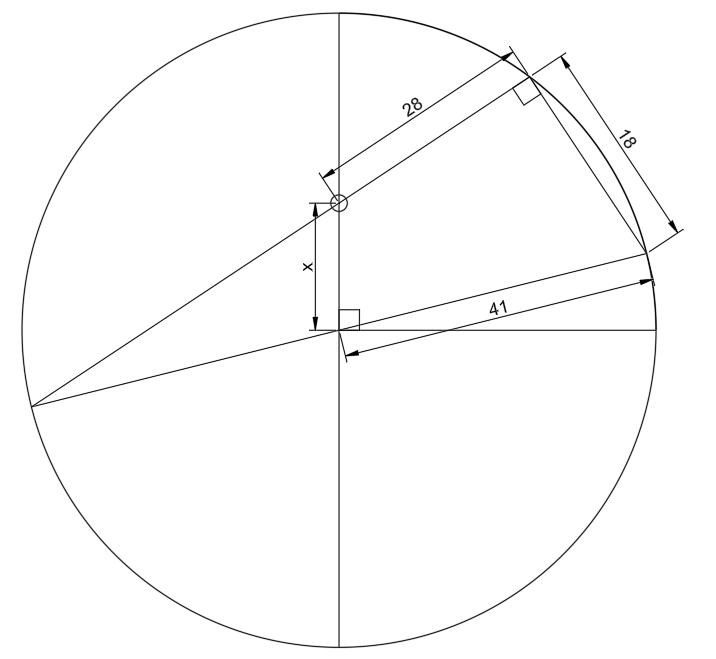
My approach would be to extend the figure to a full circle and use the intersecting chords theorem on the marked point.
41 is the radius of the quarter circle and if we were to draw the entire circle, its diameter would be 82.
Since the line of length 28 forms a right-angle with the line marked 18, if the 28 line and the 41 line were extended to the left, they would meet at the edge of the full circle.
By Pythagoras, the entirety of that extended line would be sqrt(82^2-18^2), which is 80. Since the portion to the right of the vertical diameter of the circle is 28, the portion to the left is 52.
Let’s look at that vertical diameter. Since the radius is 41, the portion above the marked is 41-x and the portion below is 41+x.
So, using intersecting chords:
28*52 = (41+x)(41-x)
1456 = 1681-x^2
x^2 = 255
Therefore the missing length is 15 units.
I since found an easier route to the answer, involving two right-angled triangles with the same base, but I’m not rewriting the whole solution now!
