A couple of general points will help us to set this up:
The greatest possible area will be achieved when the six vertices of the hexagon lie on a circle.
The order of the six sides makes no difference, so we can specify that the two 7 feet fences are opposite one another, at the north and south. This will given the field mirror symmetry in both the north-south and east-west directions
Given those points we can look at just one quarter of the circle. The 3.5 (half of 7) side is parallel to the base of the quarter circle, so we have two right-angled triangles with a shared height.
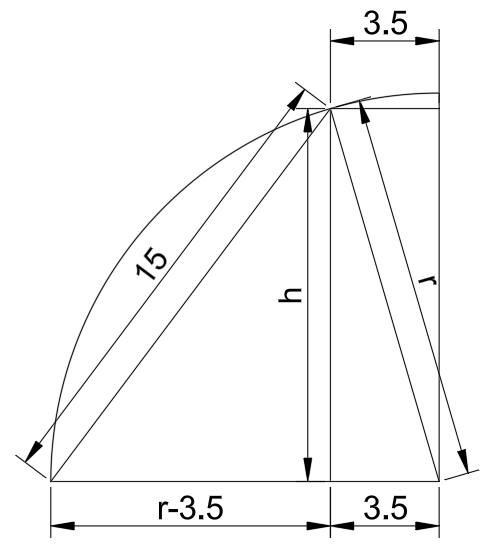
Using Pythagoras: 15^2-(r-3.5)^2=h^2=r^2-3.5^2
225-r^2+7r-3.5^2=r^2-3.5^2
2r^2-7r-225=0
Using the quadratic formula, the radius is the positive value of r, which is 12.5 feet.
We can now also go ahead and calculate h as 12 feet, meaning the area of this quarter of the field is 96 square feet and the area of the entire field is 384 square feet.
