Perform straight cuts from each of the right-angle vertices to the midpoint of the base. Hinge the two wing parts around to be above the original top vertex of the pentagon, as below:

Solution of the Week #445 - Functional Equation
As we’re hoping to evaluate f(4) we might try letting x = 4 initially:
2*f(-3) – f(4) = 540
But now we need to know the value of f(-3), so:
2*f(1/2) - f(-3)= -405
We plough on:
2*f(6/5) - f(1/2) = 135/2
2*f(5/3) - f(6/5) = 162
2*f(9/4) - f(5/3) = 225
And just as we start to lose hope:
2*f(4) - f(9/4) = 1215/4
So now we have 6 equations in 6 unknowns, let’s multiply the second equation by 2, the next by 4, the next by 8 etc:
2*f(-3) - f(4) = 540
4*f(1/2) - 2*f(-3) = -810
8*f(6/5) - 4*f(1/2) = 270
16*f(5/3) - 8*f(6/5) = 1296
32*f(9/4) - 16*f(5/3) = 3600
64*f(4) - 32*f(9/4) = 9720
Adding all of these together cancels out all of the f() terms except for f(4):
63*f(4) = 14616
Therefore:
f(4) = 232
Solution of the Week #444 - Pascal's Ladder
The bottom row will be 22081485, the 22nd of August 1485, the date of the Battle of Bosworth Field.
Solution of the Week #443 - Find the Value
(2x+3)(3x+4)(4x+5)=11
You could of course multiply the backets together and solve the resulting cubic, but I’m going to use a different method:
I note that the coefficients of x are 2, 3 and 4, and the least common multiple of those is 12, so I will multiply each bracket in order that those coefficients match (and multiply the right side by the same amount to retain equality):
(12x+18)(12x+16)(12x+15)=11*6*4*3
Next I’m going to change the variable by letting u=12x+18
u(u-2)(u-3)=11*9*8
Note I also re-factorised the right-hand side to match the format, which allows me to say that u=11. Since we are only looking for one real solution, we are now on the way to finding it:
12x+18=11
12x=-7
x=-7/12
Putting that value back through the equation confirms that this is the correct value.
Solution of the Week #442 - Triangle on a Square
A trial and error method is a good way to approach this particular puzzle, plugging in different potential values for DE, calculating DF from the similar triangles DEF and CEB, then calculating the area and perimeter of DEF. You will soon find that DE=8, DF=6, and the area and perimeter of DEF is 24.
For a more systematic approach, I used the nice fact, easily proved, that a triangle has the same area and perimeter if and only if the radius of its incircle is equal to 2. So putting in place a coordinate system where B is the origin, I place a circle of radius 2 at (22,26). Then, because I need EFB will be tangent to this circle, I construct another circle, centred on (11,13) and passing through the origin. Using the formulae of the two triangles to work out where they coincide*, I can find the point on line EFB has position (20.4,27.2). This enables me to find the position of point E to be (24,32), and the area and perimeter of triangle DEF to be 24.

Solution of the Week #441 - Puzzle 441
Each number from 1 to 441 must pair with two other valid numbers to add to two of target sums 321, 442 or 763, as the sequence goes to a number and then away from it again. For example, 13 would pair with 308, 429 and 750 to form the target sums. 750 is outside of the range of numbers in the sequence, so therefore 308 and 429 must be either side of 13 in the sequence. This is true for every number except for the numbers at the very ends of the sequence, which can only for a valid pair adding to ONE of the target sums. These are 321, which would pair with 0, 121 and 442 to form the target sums, and only 121 is in the range 1-441. At the other end of the sequence will be 221, which pairs with 100, 221 or 542. 542 is outside of the range, and 221 is the same number again, so 100 must be adjacent to 221. So 221 and 321 are at the ends of the sequence.
It's not obvious, and I won’t go into the reasons here, but at the exact middle of the sequence will be the average of those two end numbers, 271.
Solution of the Week #440 - Semicircles in a Hexagon
Let’s look at a general case where the previous radius is a/b and we wish to find the next radius x.
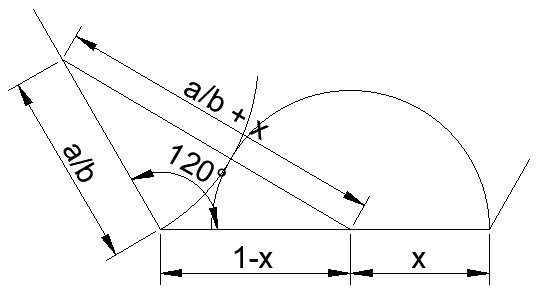
Using the cosine rule on the triangle shown, and taking advantage of the fact that cosine of 120 degrees is -0.5, we get:
(a/b + x)^2 = (a/b)^2 + (1-x)^2 + a/b(1-x)
(a/b)^2 + 2ax/b + x^2 = (a/b)^2 + 1 - 2x + x^2 + a/b – ax/b
2ax/b = 1 - 2x + a/b – ax/b
(2 + 3a/b)x = 1 + a/b
x = (1 + a/b)/(2 + 3a/b) = (a+b)/(3a+2b)
so assuming a and b are integers, x will be a rational number.
We can repeatedly use this formula starting from Ra = 1/2.
Rb = 3/7, Rc is 10/23, Rd = 33/76 and finally Re = 109/251. If you are curious, these fractions are converging on a value of
(sqrt(13)-1)/6.
Solution of the Week #439 - Odd Primes
p=13, q=r=3, s=5
p=13
p+5=18 is divisible by q
therefore q=3
q+6=9 is divisible by r
therefore r=3
r+7=10 is divisible by s
therefore s=5
s+8=13 is divisible by p
Solution of the Week #438 - parkrun Density
A good estimate would be 44. 17*1.61*1.61. In actual fact I have 55 parkruns within a 55 km radius, so slightly more spread out that the 17 mile radius which includes a couple of large cities.
Solution of the Week #437 - Rugby Scores part 2
To begin with, since we are only interested in the parity, we can calculate each subsequent value modulo 2, returning a 0 for an even number and a 1 for an odd number:
1,0,0,1,0,1,1,1,0, etc (let’s call this sequence b(n)).
Since each value only depends on the previous 6 values, we can return a 7 digit binary number for each value (using the fact that b of negative n is 0, to calculate the first few):
0000001, 0000010, 0000100, 0001001, 0010010, 0100101, etc
And then convert these into their decimal equivalents:
1,2,4,9,18,37,75,23,etc (let’s call this sequence c(n)).
Since whenever a particular number appears in this sequence it will be followed by the same number, and since there are only 128 possible values, from 0 to 127, using the pigeonhole principle, we know that the sequence must develop into a repeating loop, and in at most 128 steps.
We know that c(0)=1, and it doesn’t take much work on a spreadsheet or even by hand, to show that c(63)=1 also. So the sequence c(n), and therefore also the sequence b(n), repeats every 63 steps.
All that remains is to look at 63 consecutive values in b(n) and count how many are 0 and how many are 1.
31 are 1 and 32 are 0, and so the proportion of numbers in the a(n) Rugby sequence that are odd is exactly 31/63, or about 49.2%.
Solution of the Week #436 - Rugby Scores
There are a couple of ways to approach this. The most obvious way is to find all of the combinations of 3,5,7 can add to 23, then work out how many permutations there are of each. There are only 4 combinations: (7,7,3,3,3), (7,5,5,3,3), (5,5,5,5,3), (5,3,3,3,3,3,3).
The first combination has 5 numbers, split into 2 of one and 3 of another, so the number of permutations is 5!/(2!3!), which is 10. Doing the same for the other combinations, you get 30, 5 and 7 permutations respectively, so 52 ways in total.
A nice clever spreadsheet shortcut that I discovered is to let a(0)=1 and for anything else a(n)=a(n-7)+a(n-5)+a(n-3).
This recursive relationship very quickly reveals that 1,2 and 4 are impossible, that a(8)=2, that a(23)=52.
To see why this works, consider the score of 23. The scores that make it up must end with either 3, 5, or 7, and so before that final score is added, you would have a score of either 16, 18 or 20. And so the number of ways of making 23 must be the sum of the number of ways of making 16, 18 or 20.
As an interesting footnote, the smallest n for which a(n) requires a further digit follows an interesting pattern:
a(16)=10
a(26)=102
a(36)=1045
a(46)=10806
a(56)=112131
a(66)=1164641
a(76)=12098938
a(86)=125695132
But that’s where the pattern ends, as a(95) gives a ten-digit number of ways.
Solution of the Week #435 - A Satisfying Cancellation
The complicated expression turns out to have the value of precisely 3.
Call the sum of the two square roots ‘S’, and the difference ‘D’, the expression becomes S*sqrt(D/S)
Although S*D doesn’t appear anywhere in the expression, we will evaluate it in case it becomes useful later.
(sqrt(11)+sqrt(2))* (sqrt(11)-sqrt(2)) = 11+sqrt(22)–sqrt(22)-2 = 9.
If we look at the fraction under the square root, we can multiply top and bottom by D without changing its value. The top becomes D^2 and the bottom becomes 9. Then the square root (D^2/9) means that the whole square root expression can be replaced with D/3. Then the entire expression is just S*D/3, which of course is just 9/3 = 3.
Alternatively, change the left hand term S into the square root of S^2. Then you can combine the two square roots so that the overall expression is sqrt(S^2*D/S) or sqrt(S*D). As we saw above S*D is just 9, so sqrt(S*D)=3.
Solution of the Week #434 - Four Guesses
Your first guess is 2. Assuming you’re not correct, I had 1, 3 or 4. I must change to 2, 3 or 4.
Your second guess is 3. If your guess was incorrect, I was at either 2 or 4 and so must change to 1 or 3.
You guess 3 again. You either guessed correctly or I was at 1. I must now change to 2.
You guess 2. Checkmate!
By symmetry your guesses might have been 3,2,2,3 instead.
Solution of the Week #433 - Scores
The number denotes the alphabetical position of the first letter in alphabetical order that appears in the team name. For example Leicester City doesn’t contain a or b but does contain a c, hence their score is 3.
Therefore Everton beat Arsenal 5-1.
I’d love tickets to Luton Town versus Portsmouth!
Solution of the Week #432 - Ace of Base
The highest value is 4111111 in base 5, which is worth 66406 in decimal.
Solution of the Week #431 - Simplify
sqrt(sqrt(80)+sqrt(81))
= sqrt(4*sqrt(5) + 9)
= sqrt(4 + 4*sqrt(5) + 5)
= sqrt(2^2 + 2*2*sqrt(5) + sqrt(5)^2)
= sqrt(2 + sqrt(5))^2
= 2 + sqrt(5)
Solution of the Week #430 - 1x1x1 Rubik's Cube
The perhaps surprising answer is that every scramble can be solved in at most TWO adjacent colour swaps. The way I approached it was to separate the scrambles into three possible cases, based on the number of opposite pairs present in the scramble. This can be 0, 1 or 3. There can’t be exactly two opposite pairs present because if there were, the third opposite pair would also be there!
Of the 30 possible distinct cube arrangements, 16 are of the ‘no opposite pairs’ type, 12 have exactly one opposite pair and 2 have all three opposite pairs.
When there are three opposite pairs, you either already have the solved state or a complete mirror image of the solved state. For the mirror image you can just swap the blue and white, and the green and yellow, for instance, and you have solved the cube.
For the case where there is one opposite pair, let’s assume without loss of generality that the red and orange are opposite, but that green-blue and white-yellow are not. Looking at the RWB vertex, either it is already clockwise, in which case swapping GY will solve the cube, or RWB is anti-clockwise, in which case swapping WB will solve the cube. If Blue and White are opposite, then the RWB vertex won’t exist, but the RBY vertex will, and the same situation arises. So for the 1 opposite pair case, one swap is always enough.
For the case where none of the opposite pairs start off opposite, if you swap any one side so that it IS opposite its partner, for instance by swapping the Orange to the position opposite the Red, and you will reduce to the case where there is exactly one opposite pair present (the RO pair), and as we have already seen, that case can always be solved in just one move.
QED.
Solution of the Week #429 - Strange Stamps
There are three ways to do it:
1, 2, 5, 8, 11, 12, 13
1, 3, 4, 9, 10, 12, 13
1, 3, 5, 7, 8, 17, 18
Solution of the Week #428 - Doubly Generated Hexagon


Solution of the Week #427 - House Numbers part 2
There are 68 houses on the street.
Oddy lives at number 31 and Evelyn lives at number 56.
The odd numbers from 1 to 29 add to 225.
The odd numbers from 33 to 67 add to 900.
The even numbers from 2 to 54 add to 756.
The even numbers from 58 to 68 add to 378.