I will make use of the identity for adding tangents. If you know of a simpler way, let me know.
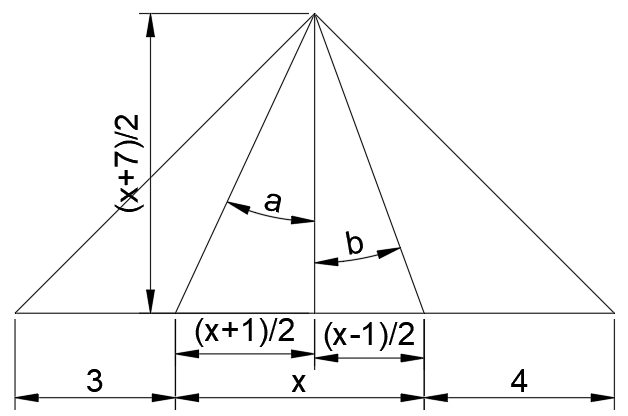
If we were to drop a line vertically down from the apex it would have a length half that of the entire base, so (x+7)/2.
The line would split the x into two parts, with the left part being 1 more than the right part (since adding the 3 or 4 makes each side equal). So the part to the left has length (x+1)/2 and the right part (x-1)/2.
We have two right angled triangles, with angles a and b.
tan(a) = (x+1)/(x+7)
tan(b) = (x-1)/(x+7)
Let’s use the tangent addition identity:
tan(a+b) = (tan(a)+tan(b))/1-(tan(a)tan(b))
But we know that a+b is 45 degrees, so tan(a+b)=1. So the denominator of the right hand side is equal to the numerator.
1-tan(a)tan(b) = tan(a)+tan(b)
1 – (x+1)(x-1)/((x+7)^2) = 2x/(x+7)
Let’s multiply each term by (x+7)^2
(x+7)^2 - (x+1)(x-1) = 2x(x+7)
x^2+14x+49-x^2+1 = 2x^2+14x
50=2x^2
x^2=25
x=5
So the missing length is 5 units long.
In fact the middle length will always be the hypotenuse of a Pythagorean triangle whose other sides are the two given lengths!