I have a number N that is simultaneously equal to 8^(x-1) and 4^(x+2).
What is the value of N?
Your Custom Text Here
I have a number N that is simultaneously equal to 8^(x-1) and 4^(x+2).
What is the value of N?
When one solver (Roger) asked this week how I came up with the puzzle about the recurrence sequence my surprising answer was that it emerged from investigations into the semicircles-in-a-segment puzzle from the week before.
Here I unite the two.
Start with a sequence where after an initial fair of 1s each term is 4x the previous term minus the term before: 1,1,3,11,41,etc.
A second sequence is the product of pairs of consecutive terms in that sequence: 1,3,33,451,etc.
Finally form a series of semicircles whose radii are the reciprocals of the numbers in the product sequence, then place them in a segment of a circle such that the diameters of the semicircles lie on the chord of the segment.
What is the radius and central angle of the segment that exactly fits all of those semicircles?
A sequence starts 1,3,21 and then every subsequent term is 5 times the sum of the previous two terms, less the term before that, so that the fourth term is 5*(21+3)-1 = 119, and the fifth term is 5*(119+21)-3 = 697, etc. The sequence continues:
1,3,21,119,697,4059,23661,137903,803761,4684659…
None of those numbers after 3 is prime.
In fact I know for certain that 3 is the only prime number in this sequence and that each of the infinity of subsequent terms is composite.
How can I possibly know that?
In this figure, an equilateral triangle is drawn within a unit radius circle. In one of the resulting segments, two identical semicircles are drawn. Finally a circle is drawn tangent to the two semicircles and the large circle.
What is the radius of this small circle?

These words have been grouped into three sets of three words according to some property.
The fact that there are three sets is a big clue. What is that property and why would trying the same thing with only two sets of words be practically impossible?
PYJAMAS
MAYDAY
SAVVY
BETWEEN
WHEEZE
TENTH
COLOURFUL
CRUCIFIX
FLOOR
If it is possible to pack 7 of these L shaped triominoes inside a circle that is inscribed in a square, how many of those same L-triominoes could you pack into the square?

ABCDE x F = EDCBA
A, B, C, D, E and F are all different digits, what are they?
In this figure, the red shapes and the partially obscured blue shape are all squares. The partially obscured green shape is a rectangle.
What are the relative areas of the visible red, blue and green regions?

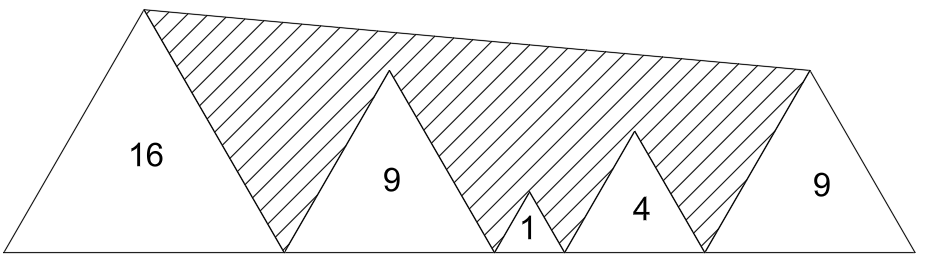
Five equilateral triangles with collinear bases have areas as shown.
What is the area of the shaded region?
Four isosceles triangles are drawn next to one another with collinear bases with length 18, 23, 27 and 38 respectively. Above these a couple of rows of rhombuses and a square are drawn.
What is the area of the square?


In the above figure, what is the value of x to the nearest integer?

We saw last week how the paths of Allesley Park are equivalent to the edges of a truncated tetrahedron.
We also saw that a path with certain restrictions was impossible for that network of paths. Let’s give that set of restrictions a name:
A Hamiltonian Cycle is one where you visit every node exactly once and return to where you started. You don’t have to use every edge.
A Eulerian Cycle is one where you must use every edge exactly once and return to where you started, but you are permitted to revisit nodes. Such a cycle is possible if and only if each node in the network has an even number of edges.
A Linean Cycle is one where you must use every edge at least once and return to where you started. You can select a minimal subset of edges to traverse a second time, but you must do so in the opposite direction to how you traversed it the first time, and also not immediately after the first time you traversed it.
We saw how a Linean cycle is not possible for the truncated tetrahedron. In fact I’ve yet to find an Archimedean solid for which it is possible, and have proved it impossible for a couple of other shapes.
Of the platonic solids (the tetrahedron, cube, octahedron, dodecahedron and icosahedron) a Linean cycle is possible for all but one of them. The octahedron is trivially possible, as it has an even number of edges at each node.
For which one of the other four is it not possible to form a Linean cycle?
We saw before how we can run the entire network of paths in 2.24 miles, by repeating the segments AC, BL, JK, HI, FG and DE. There are of course many ways of doing this.
Now I want to add extra restrictions:
If you run a segment you can’t immediately double-back and run the same segment the other way, eg you can’t go from A to C and immediately back to A. And because we are trying to form a complete cycle, you also can’t start and end on the same segment.
If you run one of the repeated segments twice in the same direction, you get penalty points equal to the distance between them, eg if you ran from D to E and later in the run ran again from D to E, you would get 14 penalty points for that segment, whereas if instead you ran D to E and later (but not immediately) ran from E to D you would not get any penalty points.
What is the fewest penalty points you can get away with?
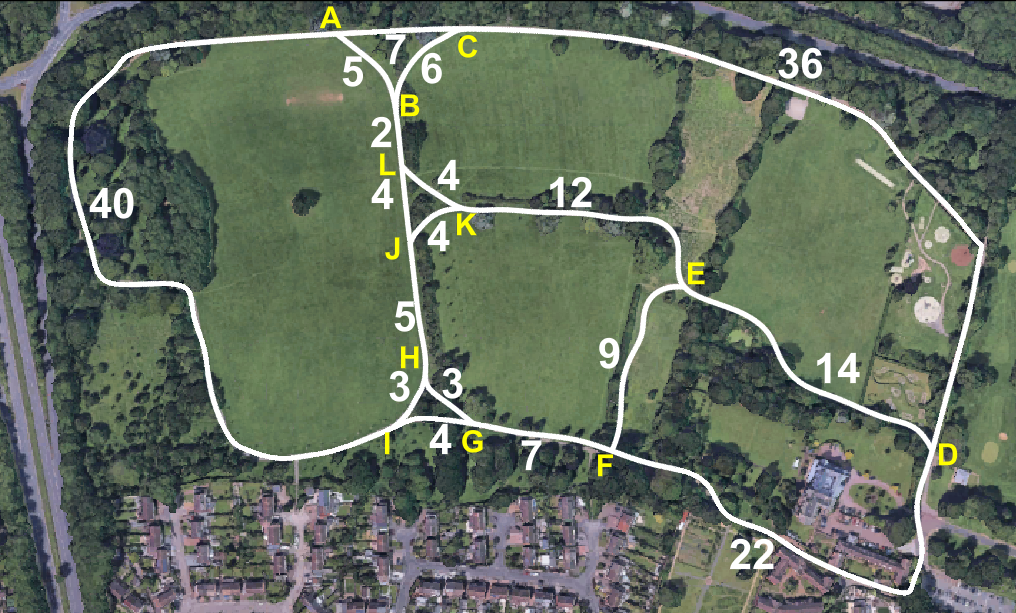
I wish to run a route that covers all of the white paths as shown, and returns to where I started. I have usefully marked all the distances between path junction points (in that well-known unit of centi-miles).
Assuming I stick to the paths, what is the length of the shortest route I can do it in?

Two straight lines divide this triangle into four regions. The area of thee of those regions is given, what is the area of the fourth?

These two geometric sequences have the same sum:
5+20+80 = 7+14+28+56 = 105
We can categorise each sequence by three parameters: the starting number, the common ratio and the number of terms. So the above sequences would be [5,4,3] and [7,2,4] respectively. For the purposes of this puzzle the parameters are all positive integers, the common ratio must be at least 2 and the number of terms must be at least 3.
Part 1: Can you find the smallest example of two sequences having the same sum?
Part 2: For the above sequences the number 4 appears twice in the parameters, as the common ratio of the first sequence and as the number of terms in the second sequence. Can you find the smallest example of two sequences having the same sum but where all six parameters are distinct?
The sum of an geometric sequence with n terms, the first of which is 1, is 127:
1 + r + r^2 … + r^(n-1) + r^n = 127
A subsequence that includes only every other term, but still starts at 1 and finishes at r^n totals 85:
1 + r^2 + r^4 … + r^(n-2) + r^n = 85
What is the sum of a subsequence that includes only every third term, but still starts at 1 and finishes at r^n:
1 + r^3 + r^6 … + r^(n-3) + r^n = S
S is the sum of an arithmetic sequence with n terms:
x_1 + x_2 + x_3 + … x_n-1 + x_n = S
A subsequence that includes only every other term, but still starts at x_1 and finishes at x_n totals 88:
x_1 + x_3 + x_5 + … x_n-2 + x_n = 88
A subsequence that includes only every third term, but still starts at x_1 and finishes at x_n totals 60:
x_1 + x_4 + x_7 + … x_n-3 + x_n = 60
What is the sum of the whole sequence S?
For bonus points if the first term is 0, what is the common difference between consecutive terms?
I have a circle of radius 19, which sits inside of an octagon, which has equal sides but not equal angles. Each of the sides of the octagon has length 17, and each of the sides is tangent to the circle.
What is the area of the octagon?