There are probably several solutions, but the one I found is:
CARBON – ACORNS – REASON – ARISEN – SERIAL - SILVER
Your Custom Text Here
There are probably several solutions, but the one I found is:
CARBON – ACORNS – REASON – ARISEN – SERIAL - SILVER
Each number is the lowest number that hasn’t yet appeared in the sequence, that begins with the last letter of the previous number.
ONE – EIGHT – TWO – ONE HUNDRED – DECILLION – NINE – ELEVEN – NINETEEN - NINETY
No numbers begin with ‘y’.
I realise I’ve been a little inconsistent with names of numbers, allowing 100 to be called ‘one hundred’ but 10^33 as merely ‘decillion’ not ‘one decillion’ but that was the only way!
Since the lines meet the edges of the square at the midpoints, we can divide the square into pairs of triangles with identical areas as below.

From the puzzle a+b=33, c+d=39, therefore the entire square, 2(a+b+c+d)=144, so the square is 12x12 and the base length of each of the eight triangles is 6. Because it is a square we also know that the a and c triangles make up half the area, and the b and d triangles make up the other. So a+c=b+d=36.
With all of this information we can determine the values of the individual areas to be a=12, b=21, c=24, d=15.
Looking only at the areas a and d will pinpoint the coordinates of the interior point (4,5).
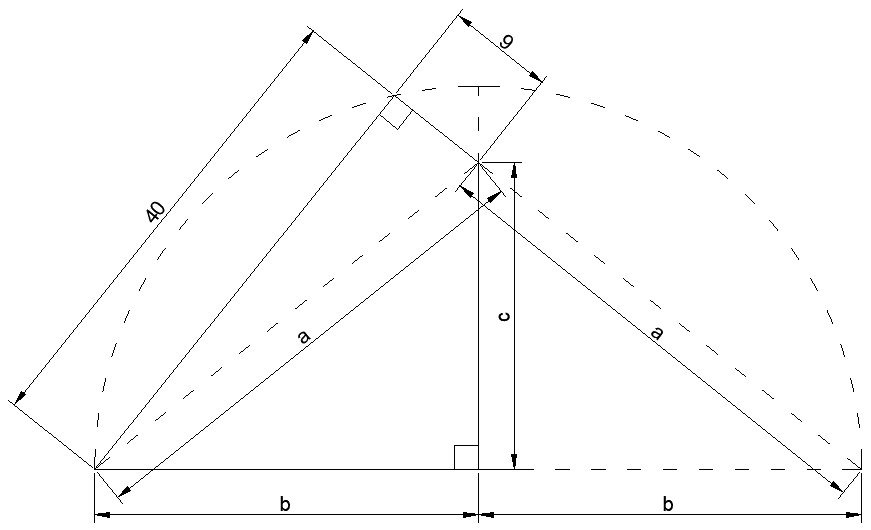
From Pythagoras on the (40,9,a) triangle, the length of a is 41. If we reflect this in the vertical axis we get a line that is collinear to the line of length 9. This gives another right-angled triangle (40,9+a,2b) and using Pythagoras again we find b=5*sqrt(41). Using Pythagoras yet a third time on the (b,c,a) triangle, we find c=4*sqrt(41). Finally to find the area of the quadrilateral we calculate ((40*9)+(b*c))/2, which neatly cancels out the square roots and gives the answer of 590.
Alternatively, the following shortcut means you don’t even have to calculate b or c: notice that the quadrilateral exceeds the 40*9 triangle by the exact same amount that the 40*50 triangle exceeds the quadrilateral. So the quadrilateral will be the average of the areas of the 40*9 triangle and the 40*50 triangle, so (180+1000)/2 = 590.
Winner 1930, nominated 2022: All Quiet on the Western Front
Winner 1961, nominated 2021: West Side Story
Nominated 1933 and 2019: Little Women
Nominated 1937 and 2018: A Star Is Born
Nominated 1935 and 2012: Les Miserables
Nominated 1952 and 2001: Moulin Rouge
Nominated 1943 and 1978: Heaven Can Wait
Nominated 1936 and 1968: Romeo and Juliet
Nominated 1934 and 1963: Cleopatra
Winner 1935, nominated 1962: Mutiny on the Bounty

If we say that class B has ‘x’ girls, and class C has ‘y’ boys, then class A has 2x girls and 4y boys. Also, we are told that class C has 2 more girls than class B has boys, but since the classes are equal that means class B has 2 more girls than class C has boys. So x = y+2. Class A has 2(y+2) girls and 4y boys, so 6y+2 students in total. Again since all classes are equally sized, class B has y+2 girls and therefore 5y+2 boys, and class C has y boys and therefore 5y+4 girls. In total there are 8y+10 girls and 10y+2 boys. Since we are told these numbers too should be equal, y=4.
Therefore class A has 12 girls and 16 boys, class B has 6 girls and 22 boys, and class C has 24 girls and 4 boys. There are 84 students in total.
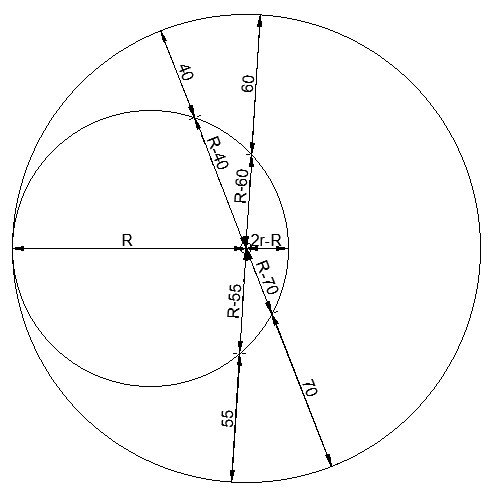
If we call the radius of the large circle ‘R’ and that of the smaller circle ‘r’, then the shaded area is pi*(R^2-r^2).
To first determine R we look at the chords that cross the small circle, then will have lengths of (R-40), (R-60), (R-70) and (R-55). According to the intersecting chords theorem, the product of the opposite pairs will be equal.
(R-40)(R-70)=(R-60)(R-55)
R^2 – 110R + 2800 = R^2 - 115R + 3300
5R = 500
R=100
So each side of the equation (R-40)(R-70)=(R-60)(R-55) will be equal to 1800.
To find r, we can draw a third chord, which goes from the tangent point, and through both centres. The intersecting chords along this line will be R and 2r-R.
R(2r-R) = 1800
200r – 10000 = 1800
r – 50 = 9
r=59
100^2 – 59^2 = 6519. The shaded region is therefore 6519*pi, which is about 20480.
It is possible for this shape to tile the infinite plane, if copies of the shape are rotated 45, 135, 225 and 315 degrees from the original. You can then overlay a unit square grid which neatly lines up with the shape as below:
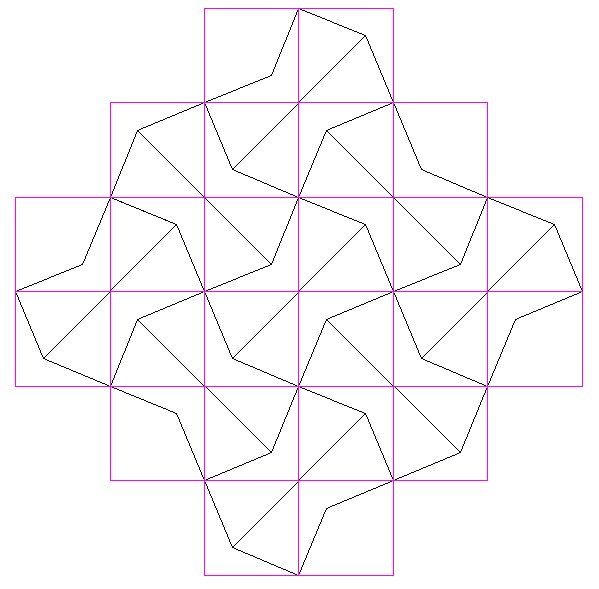
Translating this back to the original shape, this corresponds to drawing lines from the centre of the semicircle to each of the 90 degree corners, dissecting the shape into two isosceles triangles and a dart shape. Not only is this a dissection in only three pieces, but it can be hinged as well, a la Henry Dudeney.


Divide the shape into two areas as above. Because angles in a semicircle are right angles, the length marked ‘y’ is an extension of one of the ‘x’ edges, and exactly meets the bottom corner of the semicircle.
y is the hypotenuse of an isosceles right triangle whose legs are x, and so therefore y = x*sqrt(2).
Using Pythagoras on the large triangle we get that:
x^2+(x+y)^2 = 4
x^2+(x+x(sqrt(2))^2 = 4
x^2 + x^2 + 2(sqrt(2))x^2 + 2x^2 = 4
x^2 (4+2(sqrt(2)) = 4
x^2 = 4/(4+2sqrt(2)) = 2/(2+sqrt(2))
multiplying the right hand side by (2-sqrt(2))/(2-sqrt(2)) to eliminate the square root in the denominator:
x^2 = (4-2sqrt(2))/(4-2) = 2-sqrt(2)
The area of the two triangles will be respectively x(x+y)/2 and x^2/2, so the combined area is (2x^2+xy)/2. Since y=xsqrt(2), the area is: (x^2)*(2+sqrt(2)/2)
Replace x^2 with the known value of 2-sqrt(2):
(2-sqrt(2))*(2+sqrt(2))/2
(4-2)/2
1
Therefore the area of the shape is simply 1.
All prime numbers except for 2 and 3 are either of the form 6n+1 or 6n-1.
A number of the form 6n+1 can be expressed as 9+25+3(2n-11). The first two numbers are obviously composite. The last is composite whenever 2n-11 is at least 3, so when n is 7 or more. So 43, 49, 55, 61, etc. The highest prime number in this class below 43 is 37.
A number of the form 6n-1 can be expressed as 9+35+3(2n-15). Again the first two numbers are obviously composite. The last is composite whenever 2n-15 is at least 3, so when n is 9 or more. So 53, 59, 65, 71, etc. The highest prime number in this class below 53 is 47.
Therefore the answer is 47.
For completeness, the full list of prime numbers that cannot be expressed as the sum of three positive composite odd numbers is:
2, 3, 5, 7, 11, 13, 17, 19, 23, 29, 31, 37, 41 and 47.

Because triangle ABC is isosceles, and BAC and angle ACB are the same. Draw a line between C and D. Because both BAC and BDC are angles on the same chord, they too are the same.
Triangles BEC and BCD share angle CBD and have another angle in common and are therefore similar.
BC/BE = BD/BC
BD = (BC^2)/BE = 100/4 = 25
Therefore DE = 21.
Interestingly there isn’t enough information to determine the diameter of the circle, but whatever you choose it to be, DE will be equal to 21.
CERTAINTY, SET, CUR, BED, DRUMSTICK, LED, BRIBED, CURTAILED, THESAURUS, QUADRUPLE, PLENTY, ICKIER, BRIMSTONE, INTONE, RUSSET, COP, SAUCER, THE, QUAINT, COPIER
A + AB + B = 402
(A + AB) + B = 402
A(1+B) + B = 402
A(1+B) + 1+B = 1+402
(A+1)(B+1) = 403
Since A and B are positive whole numbers, A+1 and B+1 must be whole numbers at least equal to 2. 403 = 13x31, so therefore A=12 and B=30 or vice versa.
A+B = 42
ALGORITHM COTANGENT DIVISIBLE DODECAGON EXPANSION
NUMERATOR PARAMETER QUADRATIC REMAINDER TRANSFORM

That OAB and BDC are equal presupposes that AC and BD are parallel. This is an unwarranted assumption.
Instead we should work out what the angle AOB is. If OAB is indeed 32 degrees, then to complete the 180 degrees of the triangle OAB, angle AOB should be 58 degrees.
Alternatively, if we assume CDB is indeed 32 degrees, then from the central angle theorem, AOB is equal to twice 32: 64 degrees.
So both marked angle being 32 degrees leads to a contradiction.
If OAB is 32 degrees, BDC is 29 degrees, whereas if BDC is 32 degrees, OAB is 26 degrees. The only time they can be equal is if they are both equal to 30 degrees.

If we draw a line from the origin, directly through the centre of the circle and to the point where the arc and the circle meet, that line is clearly equal to R, but it is also equal to (sqrt(2)+1)*r, where r is the radius of the circle. So we have R = (sqrt(2)+1)*r, and if we square both sides (you’ll see why in just a moment) we get:
R^2 = (2*sqrt(2)+3)*r^2
We can also form a right-angle triangle using the origin and the line of length 1, to get:
R^2 = (2r)^2 + 1 = 4r^2 + 1
So we have two alternative equations for R^2, which we can equate:
(2*sqrt(2)+3)*r^2 = 4r^2 + 1
Making r^2 the subject gives:
r^2 = 1/(2*sqrt(2)–1)
Which we can make the denominator rational by multiplying top and bottom by 2*sqrt(2)+1:
r^2 = (2*sqrt(2)+1)/7
We can find R^2 by using either of the relations we worked out previously:
R^2 = 4(2*sqrt(2)+1)/7 + 1
R^2 = (11+8*sqrt(2))/7
Finally R= sqrt((11+8*sqrt(2))/7) ~ 1.7854
Now for the 3-point solution, let R^2 = x
x = (11+8*sqrt(2))/7
but we would like it to look like the quadratic formula (-b +/- sqrt(b^2-4ac))/2a , so the first thing we need is an even number in the denominator, and we also need to bring the 8 under the square root:
x = (22+sqrt(512))/14
So, a = 7, b = -22, and b^2-4ac = 512, 484 - 28c = 512, therefore c = -1
So the polynomial in x is:
7x^2 – 22x - 1
And back in terms of R is:
7R^4 - 22R^2 - 1
This polynomial has four roots, however two are complex, and one is negative, and so the only positive real root is the value for R that we previously found.
16974441796
1 = 1^2
16 = 4^2
169 = 13^2
169744 = 412^2
16974441796 = 130286^2
1,4 or 9 would satisfy the first part
16 or 49 would satisfy the next part
169 is the only number that satisfies the next part
To proceed we need a square number that lies between 169000 and 169999. By taking the square root of both those numbers, we find the only whole number between them is 412, therefore 412^2 = 169744 is the only number which satisfies the next part.
Similarly, we take the square root of 16974400000 and 16974499999 and find only one whole number between them: 130286. Therefore the answer is 130286^2 = 16974441796.

a = 120+121 = 241 (both are radii)
b = 120 (congruent triangles)
(120+c)^2 + 120^2 = 241^2 (pythagoras), c = 89
Area of square = d^2 = 120^2 + 89^2 = 22321