Puzzle of the Week #358 - Power Dates

Using the DDMMYY format, you can change a date to a six digit number, for instance 15th August 2022 would be 150822, and 1st November 2023 would become 011123. Some of these dates can be perfect powers, for instance 11th February 2024 would be 110224, which is 332 squared, and 9th November 2025 would be 091125 which is 45 cubed. You can also make 4th and 5th powers, and also one more beyond that. What is the only date that becomes a power beyond the fifth power?


Puzzle of the Week #356 - Counter Game 2

In a similar vein to my previous puzzle Counter Game, there are a number of counters on the table, but this time you can either remove 2 or 7 of them on each turn. For instance if there were 11 counter there are three solutions: 2,2,7; 2,7,2; 7,2,2; (as before removing 7 then 2 is distinct from removing 2 then 7). Some numbers of counters have no solution, for instance if there are 5 counters you cannot remove them all.

If the number of counters is high enough, there are always more different ways to remove all the counters than to leave one counter behind, but this is not true for some smaller numbers, for instance if there were 12 counters there is only one way of removing them all (2,2,2,2,2,2), but as we have seen, three ways of removing 11 and leaving 1 behind.


What is the highest number of counters, for which there are fewer ways to remove them all than to leave one remaining?

Puzzle of the Week #354 - Counter Game

I have 16 counters. On each turn I either remove 1, 2 or 3 counters until there are no counters left.

I could remove 2 counters eight times, or I could remove five lots of 3 counters then a single counter, or I could remove 3, 2, 2, 1, 3, 1, 1, 1, 1, 1, or any number of different ways.

Well in fact not ‘any’ number of different ways. Your task is to find out exactly how many ways there are. Note: the same combination but occurring in a different order counts as different ways, for instance, there is only one way using 2 eight times, but there are six ways involving five 3s and a 1.

I’ve chosen the number of counters to be 16 because the total number of ways is the square of a prime number. This fact doesn’t particularly help you, except for checking whether or not you are correct.

How many different ways are there?

Puzzle of the Week #352 - Construct-a-Wordle

You have probably seen this game going around the interwebz:

The object is to guess the secret word. For each guess you make, you will be told if a letter is correct (green), or if it does occur in the secret word, just not where you’ve placed it (yellow), or if it’s not in the secret word at all (white).

Not one to miss a bandwagon, I thought I’d make a variation on the theme:

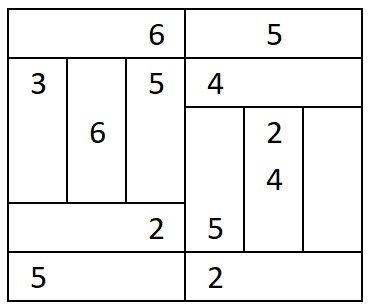
In the Wordle below, the letters for the first four guesses are given, and are above the correct column. The puzzle in threefold: firstly reconstruct what the first four guessed words were; secondly, place the four words in the correct order in the grid; thirdly, use the green, yellow and white squares from the first four rows to work out what the actual secret word should be.

Puzzle of the Week #350 - Three Sisters

There are three sisters, all of different ages, but all sharing a birthday.

At some point in the distant past, the older sister’s age was a cube number and her sisters’ ages were both prime numbers.

Now, some time later, the older sister’s age is again a cube number, and the younger sisters’ ages are again both prime numbers.

How old are they all?

Puzzle of the Week #349 - Fiendish Sudoku

In the following sudoku, within each and every 3x3 ‘box’, the rows add up to 9, 15 and 21 and the columns add up to 9, 15 and 21 (in some order).

For instance one box might be:

2 3 4

7 5 9

6 1 8

as the row totals are 9, 21 and 15, and the column totals are 15, 9 and 21.

Other than that, usual sudoku rules apply: the numbers 1 to 9 appear once each in every row, column and box.

Starting tip: list all the possible ways of totalling 9 then look at the central box.

Puzzle of the Week #346 - Corridor

There is a building whose plan view is an equilateral triangle, x feet along each side. The building is divided into an internal room and a corridor along two sides of the building, such that the area of the corridor is exactly the same as the area of the internal room. The width of the corridor is sqrt(6x) - sqrt(3x) feet. What is the value of x?

Puzzle of the Week #345 - Christmas Star

I have taken a regular hendecagon (11-sided polygon) and added extensions to each of the sides so that they intersect as shown. Wherever it is possible to connect two of these intersection points with a horizontal line I have done so, and denoted them A to P. (Except for the magenta dashed line passing through the horizontal side of the hendecagon, which has several intersection points on it, but can be ignored for the purposes of this puzzle).

Some of these lines A to P have a very curious property, that if you form a circle whose diameter exactly coincides with said line, the circle will pass exactly through the midpoints of two of the sides of the original hendecagon.

Can you list all those lines which have this property?

Puzzle of the Week # 341 - Mastermind

A code of three coloured pegs is selected from Red, Yellow, Green, Orange, Blue and Purple.


Guess 1: Red Yellow Green: one correct but in the wrong position


Guess 2: Orange Blue Purple: one correct but in the wrong position


Guess 3: Red Red Purple: one correct, and in the correct position


Solution: ?


Puzzle of the Week #340 - Infinite Coin Push

We used to play a game back when I was at school. We would start with three coins placed widely apart on a table. The first player would give one of the coins a shove, so that it would pass between the other two. Then the next player would try to do the same, starting from the current position, but using one of the other coins. This would continue until one player would inevitably fail to get the coin between the other two.


I’m now imagining an idealised version, where the coins are single points, and on each turn the coin passes through the exact midpoint of the positions of the other two coins and continues a further 50%. So to begin with, the coins are at (0,0) (3,9) and (9,3) respectively. The midpoint of the initial positions of coins B and C is clearly at (6,6), so coin A will travel from (0,0) to (6,6) and then continue another 50% to come to rest at (9,9). Next it is the turn of coin B. Coin B must travel to the current midpoint of coins A and C and extend another 50% distance to find its new position. The coins take turns in the order A, B, C, A, B, C etc

 The diagram below shows the first two moves of each coin.

After an infinite number of moves, where will each of the three coins be?